
3 Hidden Tools and Ways to Discover Digital Product Ideas That Actually Sell
Stop guessing. Start creating. A refined guide to finding profitable digital product ideas using proven research methods — no brainstorming required.
If you have ever felt stuck wondering what digital product to create next, you are not alone.
The truth is, the best product ideas are not invented. They are discovered.
They already exist — hidden in the questions people ask, the frustrations they share, and the gaps they encounter every day. Your job is not to guess what people want. Your job is to listen, observe, and translate those signals into solutions.
In this guide, I share the three methods I personally rely on whenever I decide to create a new digital product. Each method is simple, repeatable, and rooted in real human behavior. No fluff. No theory. Just practical steps you can use today.

Let’s begin.
Method One: Let Google Reveal What People Are Searching For
Google is more than a search engine. It is the world’s largest database of human problems.
Every day, millions of people type questions into Google seeking answers, solutions, and guidance. These queries are not random. They represent real pain points, genuine curiosity, and urgent needs.
And Google helps you find them — through a feature called “People Also Ask.”
How to Use “People Also Ask” to Find Product Ideas
Start by typing a broad question related to your niche. For example:

“How to support a child with autism”
Scroll down past the first result. You will see a section titled “People also ask.” Click on any question to expand it. Google will then reveal related questions, creating a branching map of what people truly want to know.
You might see questions like:
- How do you calm an autistic child during a meltdown?
- Can an autistic person live independently?
- What are the best communication strategies for nonverbal autism?
- Is autism genetic, and what does that mean for families?
Each of these questions represents a potential digital product.
Turning Questions Into Products
Once you have a list of questions, you have two options.
Option One: Use AI to brainstorm product ideas
Copy three to five related questions and paste them into an AI tool like ChatGPT or Gemini. Ask:
“Based on these questions, suggest five digital product ideas that could help parents of autistic children. Include format, target audience, and key features.”
The AI will generate ideas like:
- A printable “Meltdown Management Checklist” for parents
- A guided audio series: “Calm Communication Scripts for Autism Families”
- A Notion template: “Autism-Friendly Daily Routine Planner”
- A short course: “Understanding Sensory Needs in 30 Minutes”
- A visual social story PDF pack for teaching daily skills
Option Two: Use a dedicated research tool

For deeper insights, I use a tool I built called Query Profit Vault. It contains over 50,000 “People Also Ask” questions across 4,000 trending topics and 100 high-demand niches.
Here is how it works:
- Select a niche, such as “autism,” “gaming,” “personal finance,” or “plant-based cooking.”
- Browse trending topics within that niche.
- Click on a topic like “How to communicate with someone with autism.”
- View a visual mind map of related questions people are searching for.
- Export the questions that resonate most.
- Use them to create targeted digital products.
The beauty of this method is its precision. You are not creating content in a vacuum. You are answering questions people are already asking — which means demand exists before you even begin.
Do you Know this:Turn Free Hidden Book Libraries Into Profit: 5 Smart Ways to Sell Digital Products in 2026
Method Two: Mine Social Media Comments for Hidden Buyer Intent
Social media platforms are not just for entertainment. They are living focus groups.
Every comment section contains unfiltered feedback: frustrations, wishes, confusion, and requests. People do not always state their needs directly, but if you know how to read between the lines, you will find golden opportunities.
How to Extract Product Ideas from Comments
Start by visiting a platform like TikTok, Reddit, or YouTube. Search for content in your niche. For example:
“How to be more confident in social situations”
Select a popular video. Scroll to the comments. Look for patterns.
You might see comments like:
- “I try to practice but my mind goes blank.”
- “What if I say the wrong thing?”
- “I need something I can use right before a meeting.”
- “Is there a quick way to feel less anxious?”
These are not just comments. They are signals.
Using the Silent Buyer Detector to Decode Intent
To make this process faster and more accurate, I use a tool called the Silent Buyer Detector, available at hiddenearn.com/idea/ai.
Here is how it works:
- Copy a selection of comments from a social media post.
- Paste them into the Silent Buyer Detector.
- Click “Analyze Intent.”
- Review the report.
Within seconds, the tool identifies:
- Emotional patterns: anxiety, desire for quick wins, fear of judgment
- Audience profile: individuals seeking personal growth who have tried self-help content before
- Product ideas: “Confidence Cue Cards,” “Pre-Meeting Calm Audio Guide,” “Social Script Templates”
- Recommended formats: PDF, audio, template, or mini-course
- Pricing psychology: $7–$19 for impulse-buy digital items
- First action steps: research effective techniques, record short audio sessions, design printable cards
This method transforms vague comments into clear, actionable product concepts. You are no longer guessing what people want. You are responding to expressed needs.
A Real Example
A creator used this method in the “personal growth” niche. They analyzed comments from a TikTok video about morning routines. The Silent Buyer Detector revealed a recurring theme: people wanted structure but felt overwhelmed by complex systems.
Result: They created a “5-Minute Morning Reset” PDF template. Priced at $9. Sold over 300 copies in the first month.
The product succeeded because it solved a specific problem for a specific audience — identified directly from social media comments.
Method Three: Find the Gaps Others Are Missing
Not every niche is equally profitable. Some are saturated. Others are underserved.
The key is to identify gaps: areas where demand exists but supply is limited, low quality, or overly generic.
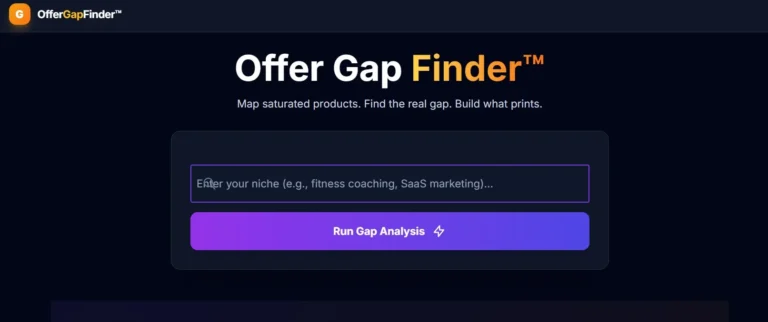
Introducing the Offer Gap Finder
To uncover these opportunities, I use a tool called the Offer Gap Finder, available at hiddenearn.com/marketgapfinder.
Here is how it works:
- Enter a niche or audience description. For example: “autism resources for busy parents.”
- The tool analyzes the market and assigns an “Opportunity Score.”
- It lists potential product ideas, labeling each as “saturated,” “crowded,” or “high-gap available.”
For the autism niche, results might look like this:
- Autism diagnosis guides — saturated
- Printable autism courses — crowded
- Autism meal planning for picky eaters — high-gap available
- Autism-friendly travel checklists — high-gap available
- Financial planning tools for special needs families — high-gap available
- Self-care resources for autism parents — high-gap available
Why Gap Analysis Matters
Creating a product in a saturated market means competing on price, marketing budget, or brand recognition. Creating a product in a high-gap market means you can stand out by simply showing up with a thoughtful solution.
The Offer Gap Finder helps you focus your energy where it matters most.
Turning Gaps Into Products
Once you identify a high-gap idea, refine it with specificity.
For example: “Autism meal planning” becomes:
“The 7-Day Sensory-Friendly Meal Planner: Printable PDF + Grocery Lists + Prep Guide for Parents of Autistic Children”
This product is specific, actionable, and addresses a clear pain point. It is not generic. It is designed for a defined audience with defined needs.
Bringing It All Together: A Simple Workflow
You do not need to use all three methods at once. Start with one. Master it. Then expand.
Here is a simple workflow you can follow:
Step One: Choose your niche
Pick a topic you care about or have experience in. Passion sustains effort. Expertise builds trust.
Step Two: Research using one method
- Use Google’s “People Also Ask” to find questions
- Mine social media comments for emotional signals
- Run a gap analysis to identify underserved areas
Step Three: Generate product ideas
Use AI or a dedicated tool to transform insights into concrete product concepts.
Step Four: Validate quickly
Before building the full product, test demand. Share the idea in a relevant community. Ask: “Would you use this? What would make it more helpful?”
Step Five: Create and launch
Build a minimum viable version. Keep it simple. Focus on solving one problem well. Then share it with your audience.
Step Six: Iterate based on feedback
Listen to your buyers. Improve the product. Add features. Expand the format. Let real users guide your evolution.
Why These Methods Work
These three approaches share a common foundation: they start with the customer, not the creator.
Most digital product failures happen because the creator built what they thought was cool — not what people actually needed. By beginning with research, you reverse that dynamic.
You listen first. You create second.
This approach reduces risk. It increases relevance. And it builds trust, because your product arrives as an answer, not an interruption.
Tools Mentioned in This Guide
All tools below are available through HiddenEarn.com:
- Query Profit Vault: A library of 50,000+ “People Also Ask” questions across trending niches. Use it to find high-demand topics and turn them into product ideas.
- Silent Buyer Detector: Paste social media comments to extract buyer intent, emotional patterns, and product concepts — complete with format recommendations and pricing guidance.
- Offer Gap Finder: Analyze any niche to identify saturated versus underserved opportunities. Focus your energy where demand exceeds supply.
- Digiplaybook: My complete framework for creating, launching, and scaling digital products. Includes bonuses like Query Profit Vault access and the full DigitaX Club suite. Learn more at hiddenearn.com/digiplaybook.
Final Thought: Clarity Over Complexity
You do not need more ideas. You need better filters.
The three methods in this guide are not about generating endless options. They are about narrowing your focus to what matters: real problems, real people, real demand.
Start small. Pick one niche. Use one method. Create one product.
Then watch what happens.
The market will tell you if you are on the right track. Listen. Adjust. Repeat.
That is how sustainable digital product businesses are built — not through guesswork, but through guided discovery.